Astrophotography solutions
Harmonique started with our own mounts, night testing and a simple need: to build our own astrophotography control system. One that can be understood, diagnosed and developed.
Today Harmonique is a group of projects forming one ecosystem. HMC controls the mount, HMCC lets you configure and diagnose it, and HAD connects everything with N.I.N.A., ASCOM Alpaca and real equipment in the field. In parallel, we develop HAC for roll-off-roof home observatories.
HMC: safe mount control
Meet HMC, a mount controller that finally lets you sleep through the night. Every astrophotographer knows the stress: will the cable wrap? Will the tube hit the tripod? When designing HMC, we focused on maximum safety and automation. Of course, the controller handles axis motion, GOTO, tracking and guiding precisely. But its most important mission is to watch over your telescope while you sleep.
No unsafe motion
HMC analyzes every command in a fraction of a second. If any movement could conflict with the current state of the mount, the controller blocks it. Hardware motion limits, intelligent parking and separate operating modes (observation vs service) help ensure that the mechanics and cabling survive every night safely.
Modern connectivity and full control
At the heart of communication is our HCP protocol. It lets HMCC give you full diagnostic insight, while the dedicated HAD driver connects the setup smoothly with N.I.N.A. and ASCOM Alpaca. Forget hunting for errors in the dark: clear logs and a safe firmware update system do the heavy lifting for you.
The production version currently runs on the proven Fysetc E4 platform. At the same time, we are working on support for the more powerful BlueTechTree Pico platform, which will enable, among other things, precise axis encoders and end-position sensors.




HMCC: configuration and diagnostics
HMCC is the application that lets you set up HMC for a specific mount and mechanical configuration. Instead of manually editing files, calculating gear ratios in Excel or guessing what is happening inside the controller, you get a clear tool for configuration, status preview and diagnostics.
This is where you check the connection with HMC, see the current mount state, read operating parameters and prepare the data needed to analyze a problem if one occurs. HMCC is designed to help in real service work.
In practice, HMCC is the technical backend of the whole system: it supports configuration, logging, firmware updates and collection of diagnostic material needed for beta testing and later Harmonique development.




HAD: the bridge between HMC and N.I.N.A.
HAD is the driver that connects HMC with astrophotography software. On one side it talks to the mount controller through the HCP protocol, and on the other it exposes the telescope as an ASCOM Alpaca compatible device. As a result, N.I.N.A. sees HMC the way it should see a normal astronomical mount.
In practice, HAD translates commands from the acquisition software into the HMC language: connection, parking, tracking, GOTO, synchronization, status reading and guiding. It also watches the communication session, heartbeats, control ownership and consistency of information returned to the application.
It is not a panel for manually clicking the mount around. HAD is an integration layer designed to work predictably in the background, keep communication stable and leave logs that show what actually happened during the session.
HAC: home observatory automation
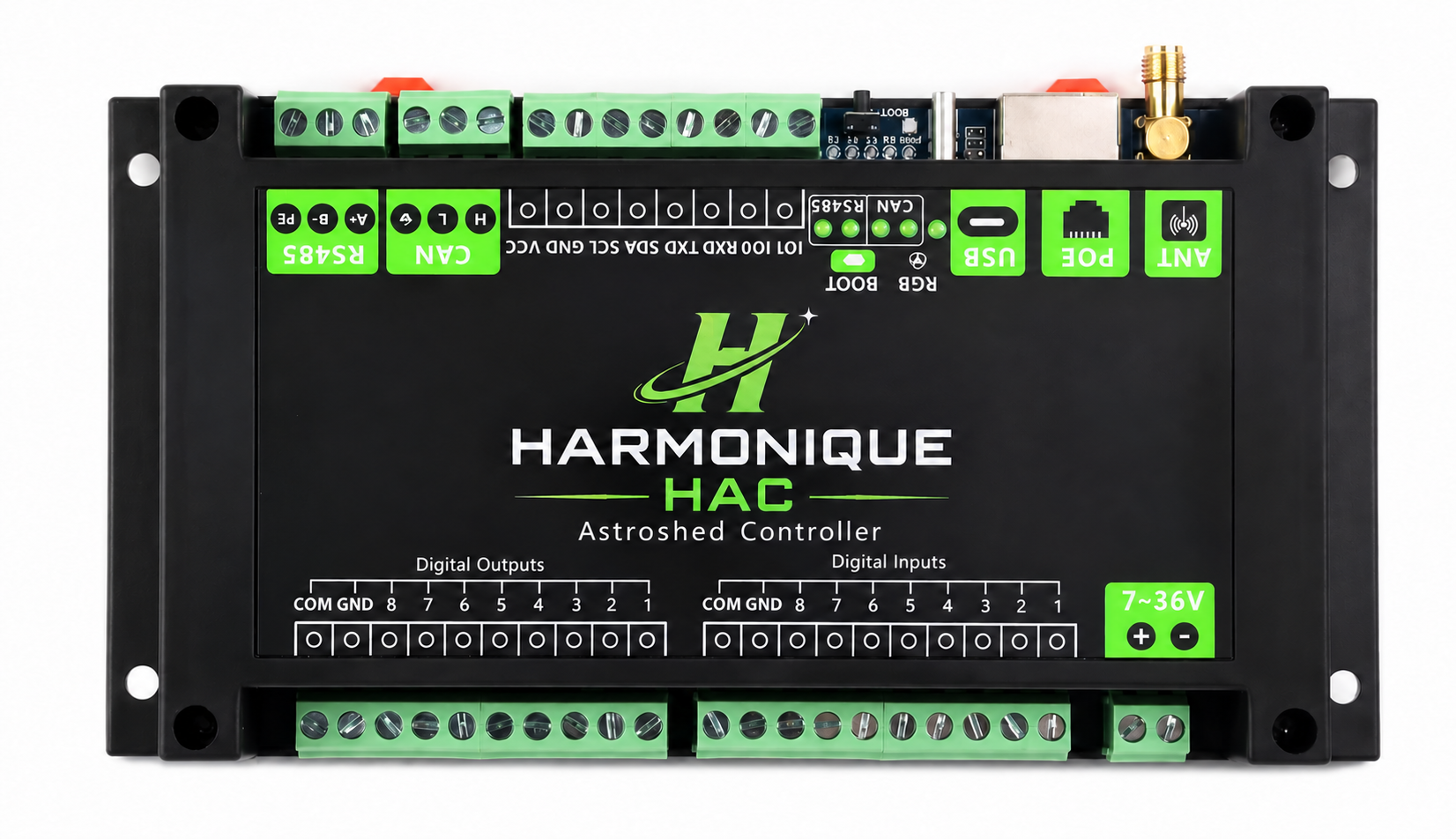
HAC is an automation module for a roll-off-roof home observatory. The current version is based on a WaveShare ESP32 controller and handles observatory roof automation, watching the safety of roof opening and closing operations.
In practice, HAC works with an astrophotography environment such as N.I.N.A. to make sure the telescope never collides with the roof.
Harmonique online
The key places connected with the project: beta testing, software downloads, manuals and community updates.